Alottabits
Alottabits — Consultancy services that drive a Continuous Competitive Learning Curve to realize maximum efficiencies and innovation speed.
We combine human-centric empowerment with the latest tools for practical process automation. Our focus is the efficient development and release of complex software solutions—helping organizations measure, assess, and optimize their workflows based on their available workforce and modern technology.
It takes a lot of bits…
The name Alottabits embodies several aspects needed to achieve sustained, reliable performance:
-
Building individual expertise — It takes time and effort to reach expertise in any domain. A deliberate process, attention and patience mount up over time to long-lasting performance. Work environments can offer this growth opportunity to their employees, creating a win-win for all parties involved.
-
Organizational excellence — Efficient collaboration and allowing employees to be part of something bigger than themselves does not happen by accident. The organization needs to apply itself deliberately towards this objective to continuously learn, adapt, and improve together.
-
Evidence-based feedback — Comprehensive data to provide evidence in the Observe–Plan–Do–Check–Act cycle is paramount for individuals as well as organizations to substantiate and guide their efforts to improve.
In today's rapidly evolving business landscape, organizations must continuously learn and adapt to stay ahead. However, this is often hindered by complex processes, fragmented data, and incomplete assessments.
As AI accelerates product development, the need for a solid validation process grows. Faster delivery demands robust verification—ensuring that what is built meets intent and quality standards. Our experience and cutting-edge tools support both continuous improvement and rigorous validation, from process insights to automated release management. Together they fuel a culture of learning and drive sustainable growth.
Services
Workflow optimization — Measure and assess the current state of your workflows, then optimize them based on your available workforce in combination with the latest technologies for practical process automation.
We help organizations:
- Map capacity, skills, and dependencies across teams
- Align requirements and acceptance criteria end-to-end
- Streamline the workflow between teams in the context of the entire solution
- Give teams the freedom to design implementations and prove they meet acceptance criteria
Our service engagements deploy tailor-made tools that combine open source foundations with domain-specific customization—built for your context, not off-the-shelf.
Tools
We have developed workflow methodologies and toolsets that power our service engagements. Two core offerings:
Agentic Release Management
A workflow process for automated validation and release management in Telco and Embedded Systems. It replaces siloed processes with a developer-native, AI-driven approach: requirements become living specifications, and AI synthesizes both product and tests against shared contracts.
As AI takes on an ever larger share of product development, a fast feedback loop through testing becomes essential. A tight, automated validation loop lets AI-driven development converge quickly and yield high-quality product releases.
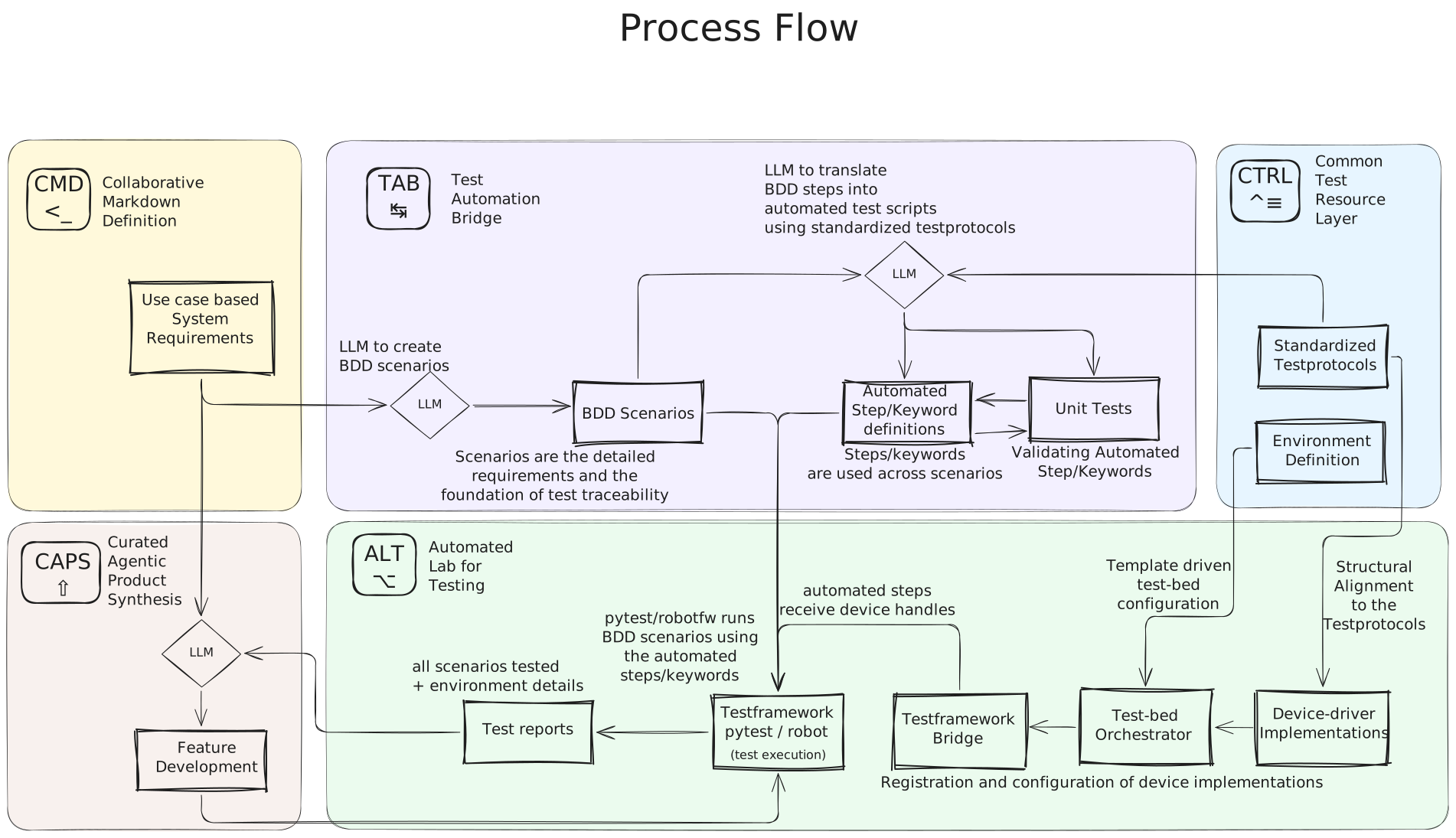
Spec the intent in Markdown. Synthesize product and tests against shared contracts.
The process runs as two parallel tracks that meet at a framework-neutral pool of standardized contracts.
Spec / Contracts
- CMD — Collaborative Markdown Definition — System behavior is captured as Markdown use cases kept in version control, so requirements are collaborated on with the same Git workflows as code.
- TAB — Test Automation Bridge — AI tools, with a human in the loop, derive BDD scenarios, automated step and keyword definitions, and unit tests from the requirements—bridging documentation to executable specifications.
- CTRL — Common Test Resource Layer — A framework-neutral environment definition combined with a pool of standardized interface contracts:
testprotocols(capability and device protocols) andtestoperations(framework-agnostic composition functions). The same test logic runs under pytest-bdd, Robot Framework, or other runners without modification.
Synthesize / Execute
- CAPS — Curated Agentic Product Synthesis — AI develops product features based on the Markdown Use Cases, with a human in the loop ensuring quality and correctness.
- ALT — Automated Lab for Testing — BDD scenarios run against real or simulated devices. pytest or Robot Framework drive the suites through a testframework bridge into testbed orchestrators and device-driver implementations, validated against environment-defined topologies.
Capturing requirements as Markdown creates traceability from requirement to execution and lets organizations treat documentation, tests, and reports with the same collaborative Git workflows as code. ARM is built on open source foundations, customized for your domain—Telco, Embedded Systems, or other complex delivery environments.
Process Mining Dashboards
Tailor-made interactive dashboards where management can drill down on Flow Metrics, Value Realized, and Maturity—without needing a large data team creating report after report.
Key capabilities:
- Flow Metrics — Investigate the complete delivery flow throughout the organization and at each integration layer. Flow Time and Flow Efficiency as top-level indicators.
- Value Realized — Deep dive into efficiency of the organization, individual teams, and interaction between teams. Drill down to team level and sprint.
- Maturity indicators — When test coverage is sufficient, trends on bugs offer a leading indicator of system maturity and on-time delivery at the needed quality level.
Dashboards are customized to align with each organization's specific business needs and process data. The interface draws on the full process data set, enabling deep data-mining and root cause analysis at the click of a button.